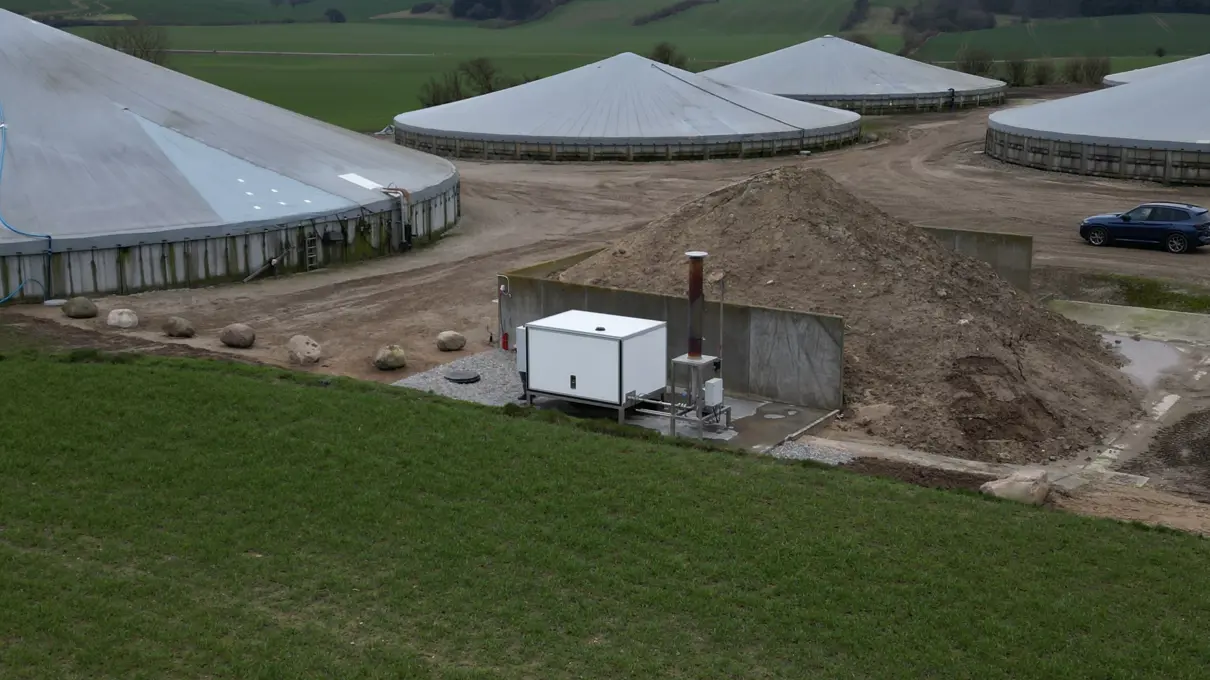
The methane technology is quite simple. It captures and destroys methane from covered slurry tanks, and since methane is 28 times more potent as a greenhouse gas than CO₂, it represents a major part of agriculture’s climate footprint. With an AgroGas plant connected to the slurry tank, Danish farmers now have the opportunity to actively reduce their emissions, and the goal is to provide an economic incentive through the sale of VERRA credits to stakeholders both within and outside the food industry.
“VERRA approval is a breakthrough – not only for Danish Crown and AgroGas, but for the entire Danish agricultural sector. We can now document and convert methane reductions into climate credits that benefit the climate and encourage investments on farms,” says Peter Foged Larsen, CEO of AgroGas.
The technology has been developed in collaboration with Danish Crown and has the potential to reduce the climate footprint of livestock production by up to 20%. The aim is for methane reduction to also be included in farmers’ climate accounts when the CO₂ tax on agriculture comes into effect in 2030.
“At Danish Crown, we are pleased that the potential we saw in AgroGas three years ago can now truly be realised. We have a cost-effective technology ready for implementation that benefits our owners, Danish Crown, and has achieved full recognition as tradable VERRA credits,” says Gustaf Bock, Danish Crown’s representative on AgroGas’ board, adding:
“With VERRA approval, there is assurance that AgroGas makes a real difference for the climate, while also securing financing for implementing the technology on farms. Now we need to work on activating our customers through our CrownFarm concept, where customers can actively reduce the climate footprint of the pork they buy by contributing financially to more farmers installing AgroGas plants.”
Methane reductions can be used in two ways: either as “insetting”, where Danish Crown’s pork products gets a significantly lower CO₂ footprint, or as “offsetting”, where companies buy credits to help improve the climate both in Denmark and globally. Offsetting can also be included in companies’ ESG reports.
“Farmers worldwide face a massive need for transformation. Consumption and demand for meat are rising, while CO₂ emissions must be reduced. Recently, the UN released the Global Methane Status Report 2025 in connection with COP30 in Brazil, calling for rapid implementation of known methane-reducing technologies in the energy, waste, and agricultural sectors if the 30% reduction target agreed at COP26 is to be achieved,” says Nicolaj Nørgaard, Chairman of AgroGas, and continues:
“This solution can help both customers and farmers reduce their emissions and strengthen sustainability profiles. It’s a win-win for the climate, society, and the industry.”
The first five plants are already operational at Danish Crown cooperative members’ farms.
Facts about VERRA
VERRA is the world’s leading standard for voluntary climate credits (Verra Verified Carbon Standard – VCS). Only projects with documented, measurable, and permanent reductions in greenhouse gases can be registered. VERRA is used globally by companies, investors, and governments as a reference for credible climate credits.
Danish Crown’s and AgroGas’ VERRA credit project can be found here:
Danish Crown Methane Destruction Voluntary Carbon Offset Group Project in Denmark (PTB) - Verra
The UN’s Global Methane Status Report 2025 can be found here