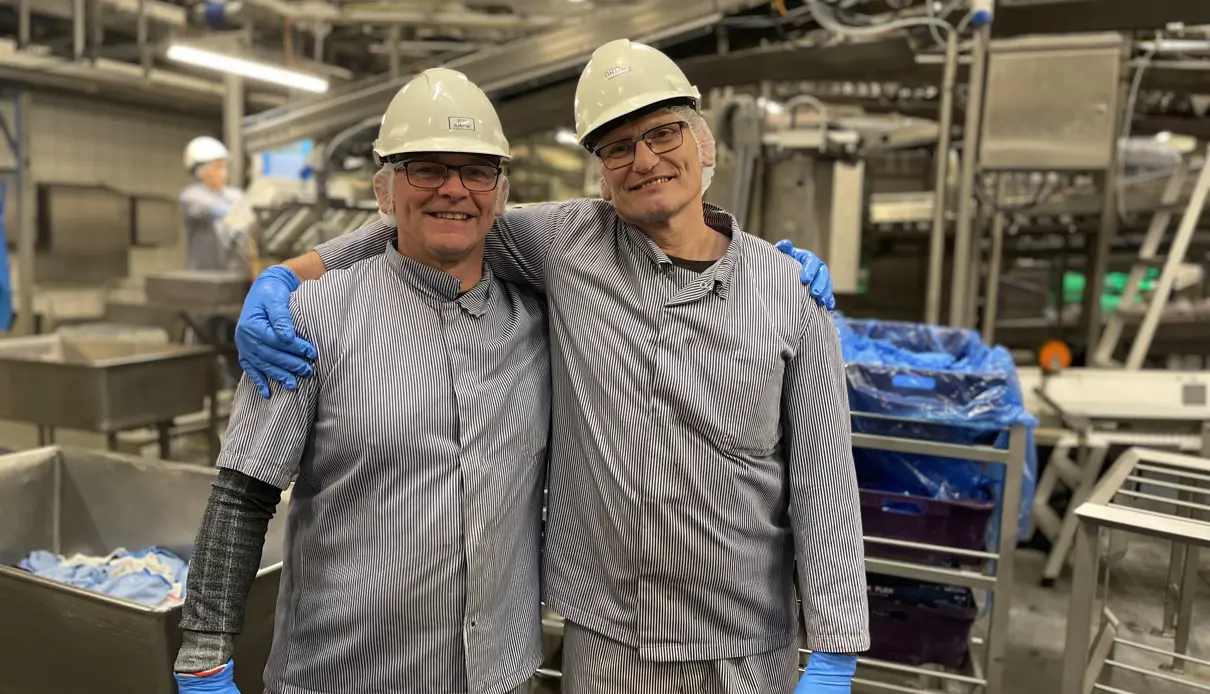
Brian Terkelsen and Bjarne Schultz are the only employees in the packaging department who do not wear hearing protection. From the outside, it may seem irresponsible, but to those who know, it makes sense. Because Brian and Bjarne are two of the four deaf employees at the Horsens abattoir, and they have been working there for 15 and 16 years, respectively.
Today, they both work as service personnel in the packaging department, but over the years, they have worked in various roles at the abattoir. Both of them are extremely happy to work at Danish Crown, where in their daily work, they do not feel particularly limited despite their lack of hearing.
- We are not given any special treatment in our daily routines, and that's actually quite nice. Everyone else wears hearing protection because there is a lot of noise in the department, where there are also many nationalities. So, a lot of communication already happens through gestures and body language among the others, and it's just a bit more so for us, says Bjarne Schultz.
Lack of hearing skills offers other skills
Both 58-year-old Brian and 58-year-old Bjarne have only been unemployed for a couple of years in their long lives, but this is certainly not the norm for the roughly 4,000 deaf people in Denmark. Several studies show that deaf individuals are not high on the wish list for companies when they are hiring new employees.
- It's unfortunate that many employers choose the "easy" solution by not hiring deaf individuals. Otherwise, we are just like everyone else, and, in fact, many deaf people are really good at working with their hands after a lifetime of sign language. Many deaf individuals also have excellent concentration and focus abilities because, for obvious reasons, we are not as easily distracted as our hearing colleagues, says Brian Terkelsen.
Peder Vejen Madsen, the head of the packaging department at the Horsens abattoir, supports this view and has nothing but praise for his deaf colleagues.
- I don't see them as particularly limited by their hearing impairment in their work; quite the opposite, actually. They simply notice more things than others and are extremely sharp at quickly addressing a challenge before it escalates. And they are just really skilled at their jobs, which are certainly not easy. They bring great value to us, and I know that many of their colleagues highly appreciate them, says Peder Vejen Madsen.
More deaf individuals are welcome
At the abattoir, there are currently no other individuals who know sign language apart from the four deaf employees. However, this does not hinder their camaraderie.
- Over the years, Brian and I have become quite good at lip-reading, and most of our colleagues are aware of that. So, with a combination of lip-reading and gestures, we can actually understand each other without major problems. And we also have fun teaching our colleagues some of the “dirtier” sign language, says Bjarne Schultz with a big smile.
Both Brian and Bjarne dream of more deaf individuals finding employment at the Horsens abattoir. They recommend Danish Crown's workplaces to all deaf individuals they meet, as places with good opportunities for deaf employment.
- It's unfortunate that many deaf people in Denmark do not have a job, especially when there are workplaces like here in Horsens where being deaf is not a significant barrier. That's why I always encourage deaf individuals to seek jobs and use Danish Crown as a prime example. It's the best way to show the world that we can work just as effectively as anyone else, says Brian Terkelsen.