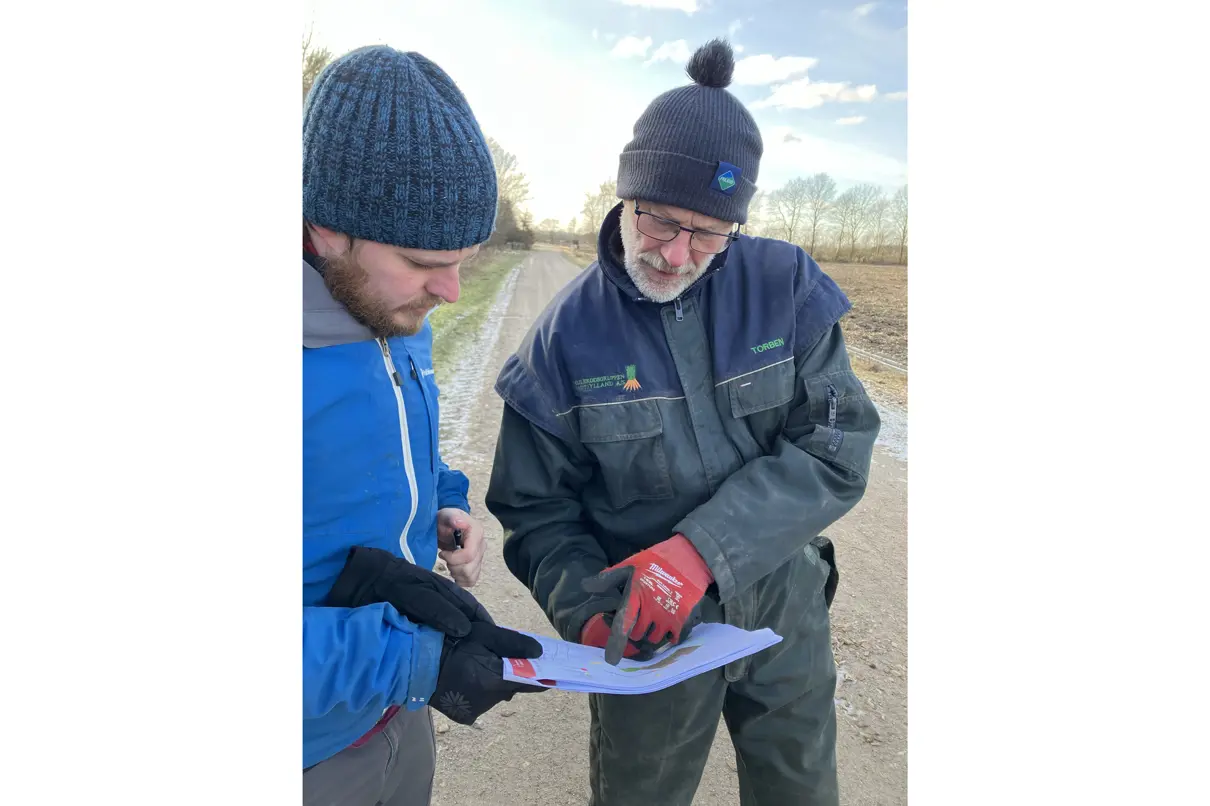
One of the first farmers to join the project is Torben Pedersen from Ejstrupholm in Central Jutland, Denmark. For almost 40 years, he has been running his family farm and supplies around 3,000 organic finisher pigs to Friland every year. Caring for the nature surrounding his land has always been close to his heart.
“Friland reached out and offered a visit — and I was curious to learn more about the possibilities,” he says.
Individual analysis and clear recommendations.
The result of this visit is a comprehensive 20‑page report that looks at Torben’s fields through a biodiversity lens and outlines three prioritized actions that can be implemented quickly and effectively. An advisor from the Innovation Center for Organic Farming combined detailed map analysis with an on‑site walk through the fields.
Even today, Torben’s farm shows a variety of valuable natural features: hedgerows, woodland areas and species‑rich meadows provide habitats for plants, insects and small wildlife.
“The analysis confirmed that many of the decisions I’ve made over the past decades were the right ones — such as planting hedgerows and investing in reforestation,” Torben explains.
Strengthening valuable habitats with simple steps.
The experts were particularly intrigued by the meadow areas and the small stream that runs along the property. Large grass tussocks provide ideal shelter for insects and small animals — potentials that Friland and Torben aim to develop even further.
Some of the key recommendations include:
- Designating moist meadow zones as micro‑habitats to better protect sensitive species — without adding work for the farm.
- Creating small openings in the woodland by selectively removing pine trees. More sunlight means space for a wider range of plant species — and more biodiversity.
- Early control of invasive species before they can displace native vegetation.
“A lot of the insights were true eye‑openers for me,” Torben says. “Especially in the forest, small steps can make a big difference.”
Shared responsibility for a more diverse landscape.
For Friland, the biodiversity project marks another important milestone on the journey toward a truly holistic sustainability approach.
“Biodiversity in Denmark is under pressure. As an agricultural company, we have both the opportunity — and the responsibility — to take action,” says Svend Schou Borch, CEO of Friland.
“With this project, we support our farmers in implementing measures that make a real difference in the landscape.”
He also emphasizes the close ties between biodiversity and Friland’s core values:
“Our commitment to animal welfare, organic principles and sustainable farming is further strengthened through this work. We are proud of the impact our farmers create for nature — and we’re confident that customers and consumers will value these efforts as much as we do.”